When you are missing several teeth, the choice can affect much more than your smile. It can change how comfortably you eat, how clearly you speak, and how confident you feel around other people. Comparing partial dentures versus implants is a sensible first step, but the right answer depends on your remaining teeth, gum and bone health, lifestyle, timeline, and budget.
A well-planned restoration should feel practical for daily life and protect your oral health over time. At Onyx Dentistry, treatment planning starts with listening to your concerns, examining your mouth carefully, and explaining the options in clear terms so you can make a decision without pressure.
What Is a Partial Denture?
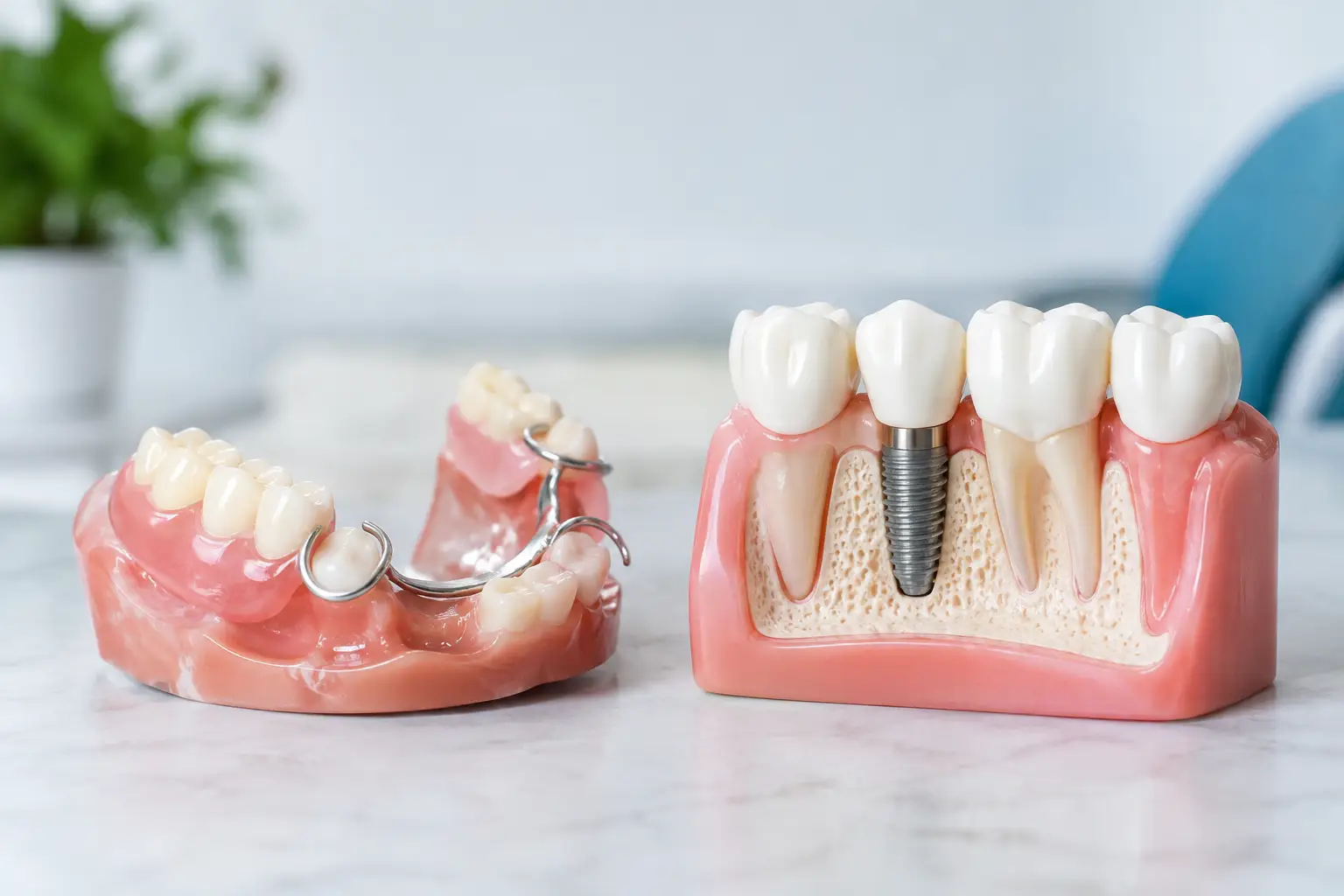
A partial denture is a removable appliance that replaces one or more missing teeth. It usually includes natural-looking replacement teeth attached to an acrylic base or a lighter metal framework. Depending on the design, it may rest on the gums and use small clasps around existing teeth for stability.
Partial dentures can be an effective solution when several teeth are missing in different areas of the mouth, especially when a fixed option is not suitable or desired. They are custom-made to fit your mouth, but they are still removable. You take them out for cleaning and usually remove them overnight, following your dentist’s instructions.
Why patients choose partial dentures
The main advantage is that partial dentures can replace multiple teeth without surgery. Treatment is often completed sooner than implant treatment, and the initial cost is usually lower. This can make a partial denture a practical choice after extractions, while healing, or when someone needs a functional solution within a shorter timeframe.
Modern partial dentures can look more natural and feel more comfortable than many people expect. However, there is an adjustment period. You may notice extra saliva, mild pressure, or slight changes in speech at first. These typically improve as your mouth and muscles adapt.
A partial denture needs regular care and occasional adjustment. Your gums and jawbone naturally change shape after tooth loss, which can make an appliance loosen over time. It may need relining, repair, or replacement to maintain a secure fit.
What Are Dental Implants?
A dental implant replaces the root of a missing tooth. It is a small post, usually made from biocompatible titanium, placed in the jawbone during a surgical procedure. Once the area has healed and the implant has integrated with the bone, it can support a crown, bridge, or, in some cases, a more stable removable denture.
For several missing teeth, implants do not necessarily mean placing an implant for every tooth. Two or more implants may support a fixed bridge, depending on the location and number of missing teeth. An implant-supported partial denture may also offer more security than a conventional removable partial.
Why patients choose implants
Because implants are anchored in the jawbone, they are designed to feel more like natural teeth than a removable appliance. They do not rely on clasps around neighbouring teeth, and a fixed implant bridge stays in place while you eat, talk, and smile. Many patients appreciate the stability, particularly if they have struggled with a loose denture.
Implants also help stimulate the jawbone where a tooth root is missing. After tooth loss, the bone in that area can gradually shrink. While no treatment can reverse every effect of past bone loss, an implant can help preserve bone once it is placed.
Implant treatment takes more time and has a higher upfront cost than a conventional partial denture. Healing is part of the process, and some patients need bone grafting before implant placement if there is not enough healthy bone available. Good daily oral hygiene and regular dental visits are essential for long-term implant health.
Partial Dentures Versus Implants: Key Differences
The most visible difference is how each option stays in place. A partial denture rests on gums and is supported partly by the remaining teeth. An implant restoration is anchored to the jawbone, giving it greater stability. That stability can make chewing easier, especially with firmer foods, although individual results vary.
Comfort is also different. A properly fitted partial denture should not hurt, but it covers some gum tissue and can move slightly during use. Implants do not cover the palate or rest on the gums in the same way. For patients who dislike the feeling of a removable appliance, an implant-supported option may feel more natural.
The impact on surrounding teeth matters, too. Conventional partial dentures may use clasps that rest against adjacent teeth. These teeth need careful cleaning and monitoring. Implant-supported restorations stand independently, so they generally do not require neighbouring teeth to be altered for support.
Cost and time are meaningful factors. A partial denture is generally the more affordable initial treatment and can often be made relatively quickly. Implant treatment is a larger investment and may involve imaging, surgery, healing appointments, restorations, and possibly grafting. The long-term value can be strong for the right candidate, but it should be weighed against your needs and financial comfort.
Who Is a Good Candidate for Each Option?
A partial denture may be a good fit if you want to avoid surgery, need to replace several teeth promptly, have medical factors that make surgery less appropriate, or prefer a lower initial cost. It can also work as an interim solution while your mouth heals after extractions or while you consider a permanent plan.
Implants may be appropriate if you have healthy gums, sufficient jawbone or are suitable for grafting, and can commit to careful maintenance. Smoking, uncontrolled gum disease, untreated decay, certain health conditions, and clenching or grinding can affect the treatment plan. These factors do not always rule implants out, but they need to be addressed honestly before treatment begins.
Age alone is not the deciding factor. Many older adults are excellent implant candidates, while younger adults may benefit from a partial denture or other option depending on their oral health. A clinical exam, digital X-rays, and sometimes 3D imaging help determine what is safe and predictable.
Everyday Care and Long-Term Maintenance
Partial dentures should be removed and cleaned daily with a denture brush and products recommended by your dentist. Avoid hot water, which can warp the material. Clean your natural teeth, gums, and tongue thoroughly as well, since plaque can collect around clasps and along the gumline.
Implants cannot get cavities, but the gums and bone around them can become inflamed or infected if plaque is allowed to build up. Brush twice daily, clean between teeth with the tools recommended for your restoration, and keep regular hygiene visits. A fixed implant bridge may require special floss, interdental brushes, or a water flosser to clean underneath it.
No replacement option is maintenance-free. The best results come from treating the restoration as part of your overall oral health, not as a one-time repair.
How to Make the Decision Feel Less Overwhelming
Start with what you need most right now. If you are dealing with missing teeth after an extraction, difficulty eating, or embarrassment about a gap, a partial denture may provide timely relief. If your priority is long-term stability and you are comfortable with surgery and a longer treatment process, implants may better match your goals.
Ask for a treatment plan that explains the expected timeline, the number of visits, any need for bone grafting or periodontal treatment, how the restoration will be maintained, and the full anticipated cost. Insurance coverage and Canadian Dental Care Plan eligibility can vary by treatment and individual plan, so it is worth reviewing these details before you begin. Direct insurance billing can also make the process easier to manage.
Missing teeth deserve thoughtful care, not a rushed choice. A personal assessment can show you what is possible in your mouth and help you move forward with a replacement option that supports comfortable eating, healthy gums, and a smile you are happy to share.